
New Rochelle Directory Collection Shelf
| Collection | Years | Where Held | Access |
|---|---|---|---|
| Turner’s Annual Directory | 1901–1910 | E.L. Doctorow Local History Room, LH 917.47 | Reference collection during regular library hours |
| Turner’s expanded territory edition | 1911 | E.L. Doctorow Local History Room, LH 917.47 | Reference collection; includes Mamaroneck |
| Richmond’s Annual Directory | 1912–1928 | E.L. Doctorow Local History Room, LH 917.47 R414 | Request the individual year at the reference desk |
| Polk’s Directory, including the Pelhams | 1929–1960 | E.L. Doctorow Local History Room, LH 917.47 P759n | Check individual-volume availability with staff |
The New Rochelle Public Library local-history collection is the main shelf for these volumes. Its materials are non-circulating, so a directory is consulted in the second-floor E.L. Doctorow Local History Room rather than borrowed. The documented sequence is useful, but it does not prove that every annual issue survives or is online. The library’s condensed index lists selected volumes and call numbers, making the year and call number a better request than a broad search for a surname.
New Rochelle appears within broader place names in several titles. Turner covered New Rochelle, Larchmont, and Pelham from 1901 through 1910, then added Mamaroneck in 1911. Richmond continued the earlier territory through 1928. Polk then included the Pelhams. A name absent from one title may reflect coverage, an omitted issue, a changed spelling, or a move. It should never be treated as proof that a person was not in New Rochelle.
New Rochelle Directory Years With Turner
Turner’s run gives New Rochelle researchers a defined starting span from 1901 through 1911. The 1911 title is a useful territorial warning because it adds Mamaroneck. Keep the title page with the notes for any entry. A directory can place a household in the New Rochelle area, but the wider title may include a neighboring town. The Sutton Manor historic-resource survey bibliography independently lists the Turner sequence and is a good check on publisher and date.
| 1901–1910 | Turner’s Annual Directory of New Rochelle, Larchmont and Pelham. |
|---|---|
| 1911 | Turner’s Annual Directory of New Rochelle, Larchmont, Pelham and Mamaroneck. |
| Use | Record the exact town wording before drawing an address or household conclusion. |
That title change also helps explain why a surname may seem to enter or leave a search unexpectedly. Use the street and municipality printed in the entry, then compare the next available volume. A close match can be a strong lead, not a final identification.
New Rochelle Directories After 1911
Richmond’s annual directories run from 1912 to 1928, followed by Polk’s New Rochelle directory from 1929 to 1960. The library identifies the Richmond shelf mark as LH 917.47 R414 and the Polk shelf mark as LH 917.47 P759n. These call numbers are practical search terms at the reference desk. They also separate the title sequence from a claim of uninterrupted scans or a complete online run.
- 1901–1910: Turner’s New Rochelle, Larchmont and Pelham edition.
- 1911: Turner expands the title to include Mamaroneck.
- 1912–1928: Richmond provides the next documented local sequence.
- 1929–1960: Polk provides the later documented sequence, including the Pelhams.
These dates form a usable New Rochelle directory timeline, not a promise of a volume for every year. The condensed index specifically lists Richmond entries for 1912–1919, 1920, 1922, and 1924–1928, plus Polk entries through the 1940s and 1950s. Ask staff to confirm the year in hand before relying on a gap-free timeline.
Note: A volume title and call number are part of the citation, not decoration.
New Rochelle Directory Room Access
The E.L. Doctorow Local History Room is public during regular library hours. Alongside New Rochelle directories, it holds more than 2,500 local-history books, pamphlets, maps, and atlases; several hundred oral histories; nearly 10,000 photographs and postcards; and more than 55,000 reproduced newspaper and magazine clippings. Archivist David Rose, librarian Larry Sheldon, and the reference desk are listed by the library as local-history contacts. The room’s indexed, non-circulating material is especially useful when a directory entry needs a newspaper, map, or biography check.
The library’s local-history page shows the collection setting for this New Rochelle city directory work.
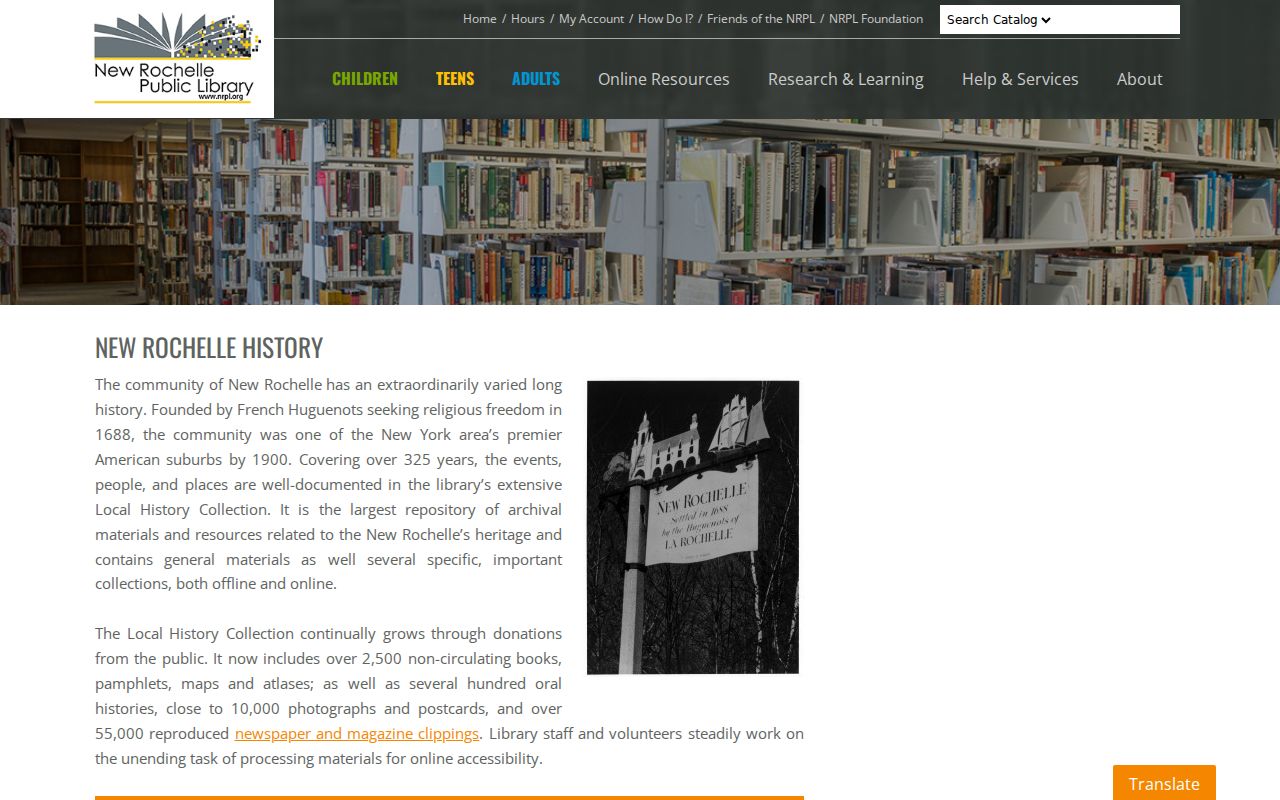
Use the image as a reminder that the directory shelf is part of a larger reference collection. It is reasonable to ask for the year, title, and call number together, then consult clippings, maps, or a yearbook only after an entry gives a date or address worth checking.
The library also provides cardholder access to HeritageQuest, which includes census and directory material. That access supplements the local shelf. It does not turn an unverified scan or a database transcription into a substitute for the printed volume.
Decoding a New Rochelle Directory Entry
No readable individual New Rochelle directory entry was captured in the research. For that reason, there is no invented sample line or assumed set of abbreviations here. When a volume is open, transcribe only what the entry actually prints, including punctuation, initials, a spouse or relationship notation if present, address, occupation or business line, telephone, owner or renter mark, and widow notation. Photograph or note the volume’s abbreviation key before expanding a shorthand mark.
| Name as printed | Exact surname, initials, and spelling; do not silently modernize it. |
|---|---|
| Relationship notation | Spouse, widow, or other notation only if the volume prints one. |
| Address and occupation | Copy both exactly, together with a telephone or business line if shown. |
| Source details | Volume year, page, title, call number, and repository location. |
- Criss-cross directory
- An address-ordered section used to approach a location rather than a name, when the specific volume actually includes one.
- Householder index
- A name listing organized around a household or address. Its scope must be checked in the volume.
- Abbreviation key
- The printed explanation for the volume’s shortened terms and marks. It prevents a guess from becoming a false fact.
New Rochelle City Directory Address Paths
Telephone and Richmond directories are described by the library as dating from 1900, and address-oriented local-history resources are available. A separately titled, complete reverse or criss-cross run was not found during the research. That gap matters. Confirm with library staff that a particular year has an address-to-name section before promising a reverse search for a New Rochelle house.
The digitized Westchester and New Rochelle directory listing can help identify online historical material, but the library volume remains the source for checking title, coverage, and page context.
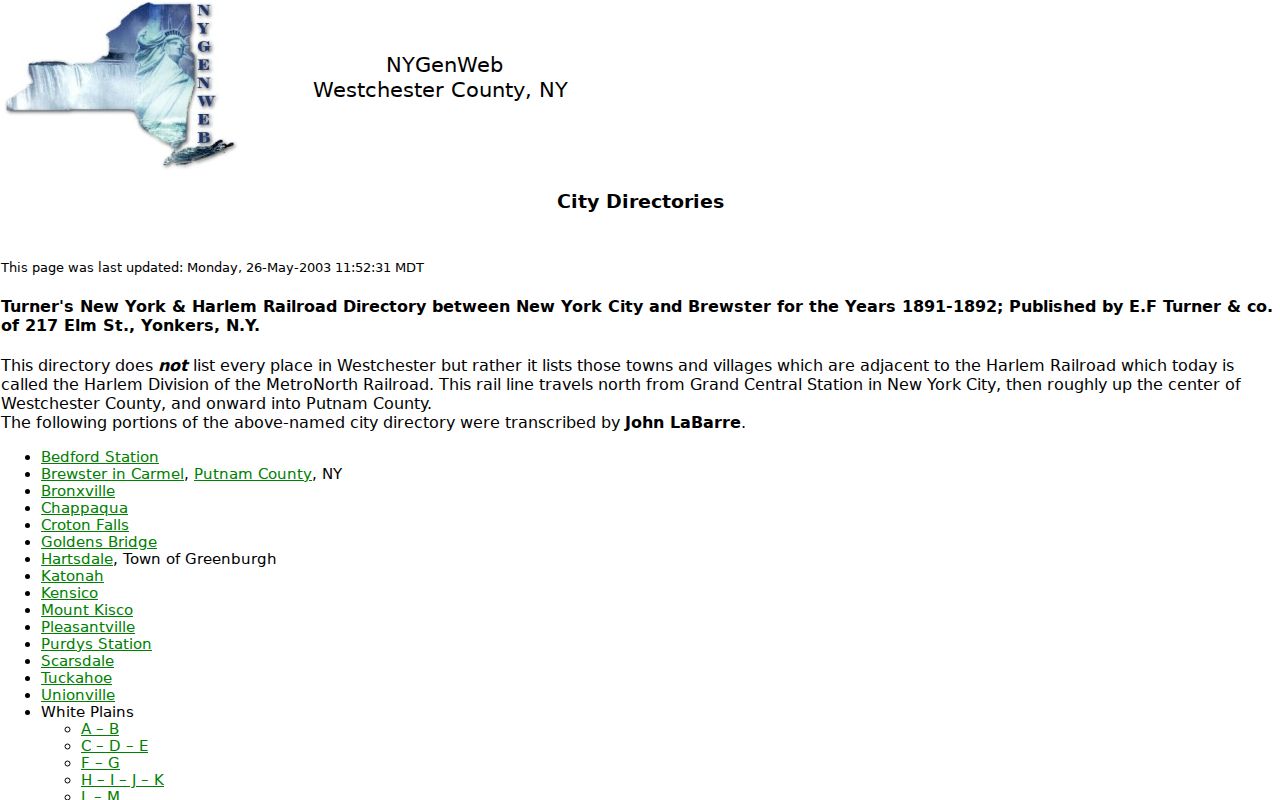
A digitized directory lead should be compared with the printed title and the year shown in the local collection. When the aim is a present-day street record rather than a historic household, use the separate New Rochelle street directory lookup route instead of extending a directory entry beyond its date.
Trace a New Rochelle City Directory Household
Household tracing works by keeping each annual finding separate until two independent records support the connection. Start with a full name and likely year. Copy the entry faithfully. Then repeat the search in the next available volume and mark a move or no listing without assigning a reason. The research procedure pairs local volumes with the nearest federal census years, because a directory may be issued in a different year and may list only one household member.
- Find the name in the nearest available New Rochelle directory and copy every printed detail.
- Check the next available year, preserving changes in spelling, initials, address, and notation.
- Use an address section only after confirming that the volume has one.
- Pair the entry with the nearest 1900, 1910, 1920, 1930, 1940, 1950, or 1960 federal census year.
- Use deeds, tax material, probate, obituaries, or clippings to separate people with the same name.
- Cite the volume, year, page or call number, and New Rochelle repository for every conclusion.
A disappearance can mean a move, a changed household listing, a missed volume, or death. It is a question to test with the next record, not an answer by itself. A later person check belongs in a modern New Rochelle resident lookup, where current records have different access limits.
New Rochelle Directory Companions
New Rochelle High School and other yearbooks run from 1914 to the present in the library collection. Fleur-de-Lis covers 1914 through 1922, and The Rochellean begins in 1923. A class year, portrait, club, or name spelling can help distinguish a former classmate from another person of the same name. It still needs corroboration from a directory, clipping, or other dated record.
The library’s clippings run from the 1920s through 2021, with later newspaper and veterans clippings available on in-house computers. Search a person in the BIOGRAPHY files, then use organization, house-of-worship, or club headings for additional context. The New York State Library newspaper holdings identify the New Rochelle Pioneer, Evening Standard, and New Rochelle Paragraph microfilm runs that can help place a directory entry in its local news period.
New Rochelle Residents Beyond Listings
A directory records a short point in time. The Local History Room also holds oral-history collections that make New Rochelle resident research more human and more precise. The 1988 Tricentennial collection contains interviews with 41 long-term residents. Other collections preserve the Antonio Valencia community history, Davids Island and Fort Slocum memories, and experiences connected to Taylor v. New Rochelle Board of Education.
These sources are not proof of a particular person’s address. They can, however, explain a neighborhood, organization, school, or period after a name has been responsibly anchored in a dated directory or another source. This is especially useful for family history when a person’s community connection matters as much as a street number.
New Rochelle Research Room Geography
New Rochelle historical work is spread across the library, the Westchester County Clerk in White Plains, and the County Archives in Elmsford. The archive’s online holdings include deed grantor and grantee indexes from 1680 to 1907, estate records from 1782 to 1909, and maps from about 1766 forward. That county layer is useful when a New Rochelle family or address predates the printed directory sequence, especially because local vital records begin only in 1881.
The Westchester Archives reading-room information sets out the in-person route for older material.
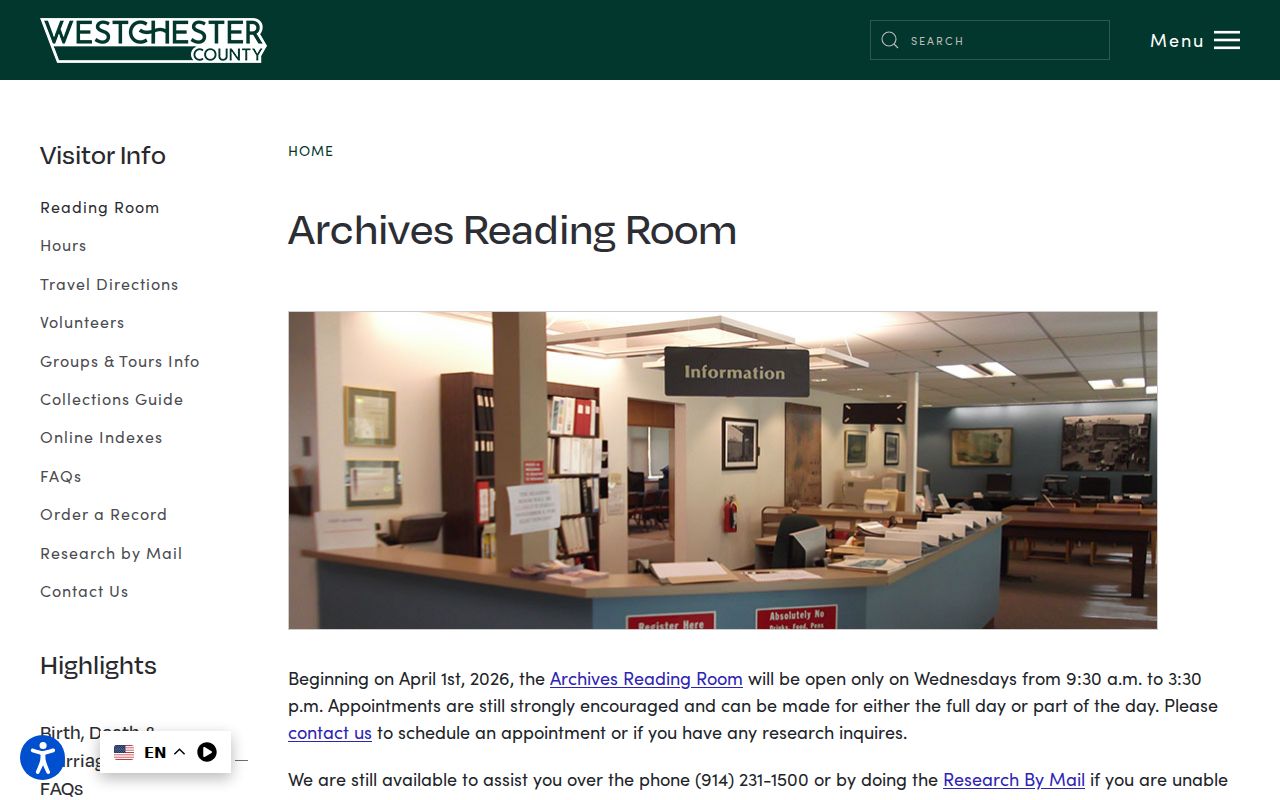
The reading room is public Tuesday and Wednesday from 9 to 4, except government holidays, and requires a research application and photo ID. Call slips and staff retrieval apply because storage is closed, with a three-item maximum at a time. Plan the library directory request and the archive visit as separate steps, since they are different collections in different places.
Note: Archive access can be restricted by statute, donor terms, origin, or fragility.