
Finding New Rochelle Residents
Pick a New Rochelle residents directory source from the fact you hold. Skip the broad name search. An address belongs first with the City Assessor or the Westchester parcel layer. A historic name belongs with the New Rochelle Public Library's directories, yearbooks, and clippings. A current registration question goes to the New York voter lookup. County deeds and court files can then corroborate a date, parcel, or party name. Each source records a different relationship. That means a tax owner and a deed party are never the same. A voter is never the same kind of listing either.
New Rochelle records sit across City Hall, White Plains, Elmsford, and statewide systems. That spread helps when one search stalls. It also sets limits. A parcel owner may receive tax mail elsewhere. A protected voter may not appear at all. A directory can list only one member of a household. Compare two independent details, like a dated address and a parcel key. Then decide whether one record belongs to one person.
- Start with the New Rochelle assessment roll or the county parcel map when you have an address.
- Carry the street location, owner name, and SBL or PRINTKEY into a deed or court search when the question needs confirmation.
- Use the New York voter lookup only to check its stated registration and poll-service purpose.
- For a past household, ask the E.L. Doctorow Local History Room for the right directory volume, yearbook, clipping, or map.
- When an index omits the period, make a focused FOIL or custodian request with the date range, name spelling, address, SBL, or document type.
Note: A New Rochelle residents directory search maps a public record trail, not a private roster of every household.
New Rochelle Records Geography
One city search can demand three different offices. City Hall on North Avenue is the municipal starting point for assessments, local vital records, permits, and City Clerk routes. White Plains holds the County Clerk and Surrogate Court. Elmsford holds the Westchester Archives reading room with older indexes, maps, and Historical Society materials. These counters are not interchangeable. The county archive asks visitors to apply, show photo ID, use call slips, and work with staff retrieval, with a maximum of three items at a time.
Geography also explains why a web search is not the last step. Westchester Archives offers deed grantor and grantee indexes from 1680 to 1907, mortgagor indexes from 1680 to 1897, estate records from 1782 to 1909, and maps from about 1766 forward. Its research-by-mail route lists a $15 individual search, $25 hourly custom research, and $0.50 per page after the first ten. Call ahead before an in-person records visit. Archive hours and access restrictions apply.
New Rochelle Resident Records Offices
New Rochelle records have three physical centers. The City Assessor handles parcel, assessment, and transfer information in New Rochelle. The Westchester County Clerk keeps land and legal-record routes in White Plains. Westchester Archives in Elmsford holds older deed, estate, map, and historical materials. The City Clerk manages local vital records and citywide records-access routing. Choose the office that owns the record before requesting a copy. The detailed address path belongs in the New Rochelle street directory.
Westchester Records Online helps with county land, legal, map, and trades material. The County Clerk notes that online records are distinct from official certified records. The City Assessor's roll identifies a current tax owner. It lists parcel facts, not every person at an address. The voter lookup is a narrow individual service. It is not an export of all voters on a street.
Westchester County Clerk
Richard J. Daronco Courthouse
111 Dr. Martin Luther King Jr. Boulevard, White Plains, NY
914-995-3080
New Rochelle Assessor
City Hall
515 North Avenue, New Rochelle, NY 10801
914-654-2052
Westchester Board of Elections
445 Hamilton Avenue, 8th Floor
White Plains, NY 10601
914-995-5700
New Rochelle Parcels Before Names
When an address is the only solid starting point, the county parcel layer helps. It builds a useful New Rochelle residents directory bridge. It records fields like property address, ZIP, owner name, owner mailing address, property class, SBL, and PRINTKEY. The assessment roll adds class, assessment, exemption codes, school district, tax description, and grid information. The property location is the situs, the physical parcel spot. The owner address is where tax mail goes. That can be outside the city, and it is not proof the owner lives there.
Carry the SBL or PRINTKEY forward to the assessment roll. Go on to a land-record search when needed. A legal description may stay consistent even when a postal address changes. The Westchester New Rochelle parcel layer supports address text, geometry, spatial relationship, out-field, count, pagination, and output-format controls. Its 2,000-record maximum matters. It is one reason not to treat a single map view as a full street result.
| Parcel field | Meaning | How to use it |
|---|---|---|
| SBL / PRINTKEY | Tax-map parcel identifier | Carry it to the roll, deed reference, or map |
| PROPADDRESS | Property situs | Confirm the parcel's physical location |
| OWNERNAME | Tax owner field | Use as a verification lead, not a household claim |
| OWNERADDRESS | Tax-mailing field | Keep separate from the situs address |
| PROPERTYCLASS | Assessment classification | Read with the roll's assessment context |
New Rochelle Voter Lookup Boundaries
The official New York voter lookup asks for county, last name, first name, date of birth, address information, and ZIP Code. It serves registration, poll-site, and mail-ballot needs, with JavaScript and cookies required. Enter the registered spelling and the date format the tool shows. A missing match does not prove a person moved or is unregistered. Spelling, address changes, status, and protected registration can all affect what appears.
| Lookup field | Type | Observed format or role |
|---|---|---|
| County | Selector | Choose the county for the registration search |
| Last and first name | Text | Use the registered spelling |
| Date of birth | Text | MM/DD/YYYY format shown by the state tool |
| Address information | Text | Used to narrow the individual lookup |
| ZIP Code | Text | Postal field in the search form |
New York draws a sharp line between two things. One is a public voter lookup. The other is a full voter-data request. Under Election Law §3-103, anyone requesting registration data must state an election purpose. Election Law §5-508 keeps certain protected registrations out of public inspection entirely. The 2024 county enrollment report counts 46,743 active registered voters in New Rochelle. That figure is civic context. An aggregate total tells you nothing about one household. It cannot serve as a residents directory.
The official voter and poll-site search, shown in the screen, offers only one route. It is an individual lookup. It is not a by-street directory.
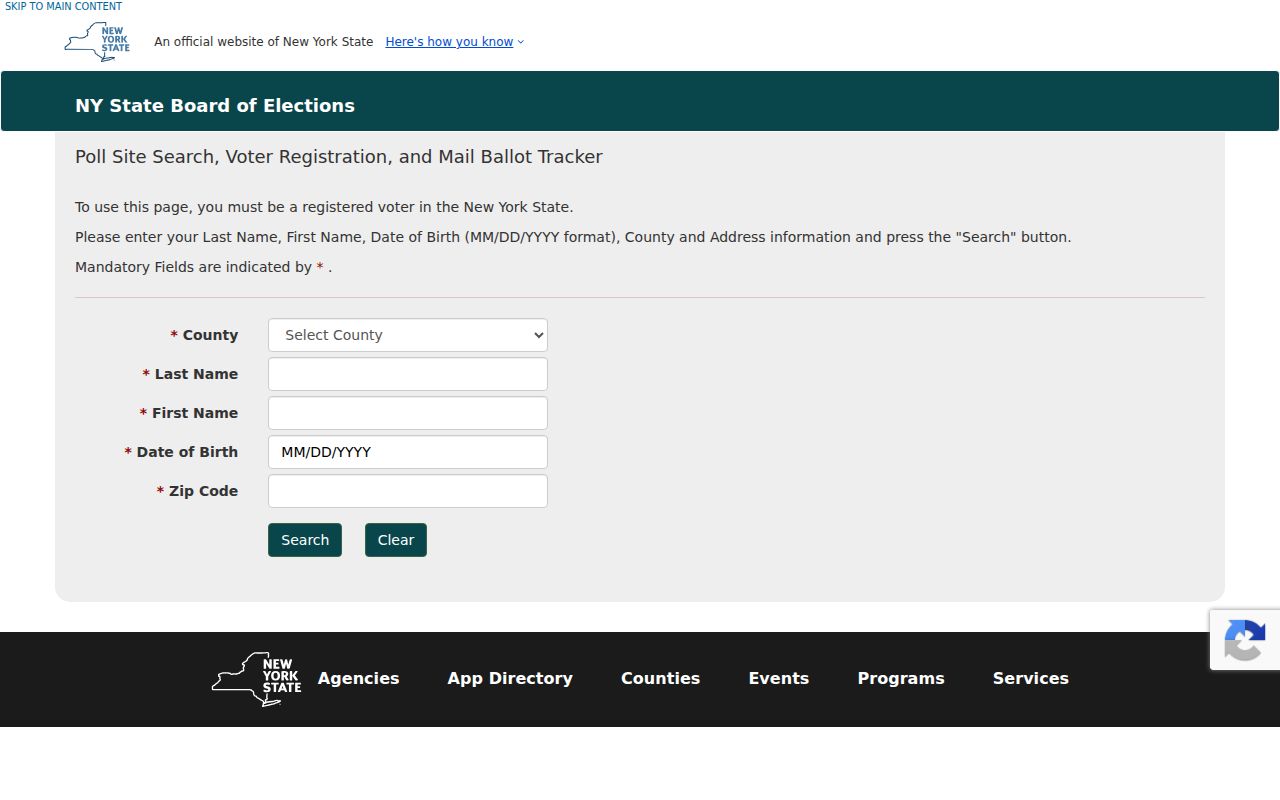
That limit is the point. A New Rochelle residents directory workflow should treat the voter tool as a single-purpose service the state defines, not a way to assemble a resident list.
Note: Protected voter registration exists as a safety measure and is not a missing-record puzzle to solve.
Current New Rochelle Resident Directories
No single source lists every New Rochelle resident. Each directory-like record shows one slice of a public relationship. The assessment roll ties tax parcels to owners and mailing fields. Westchester GIS links a parcel polygon to owner and address fields of its own. WRO names parties to county land and legal records. The state voter tool handles one registration at a time. A court docket can surface a party name. Sealed, juvenile, adoption, and many Family Court records stay excluded or restricted.
| New Rochelle source | Relationship shown | Custodian | Access route |
|---|---|---|---|
| Assessment roll | Tax owner, situs, mailing, class | New Rochelle Assessor | Public roll and office |
| Parcel GIS | Parcel, owner fields, adjoining geometry | Westchester County GIS | Public viewer and REST layer |
| WRO land records | Deed and legal-record parties | Westchester County Clerk | Search, account for images, Clerk for certified copy |
| Voter lookup | Registration and poll-service check | New York State Board of Elections | Individual web lookup |
| Local-history collections | Dated directory, yearbook, clipping context | New Rochelle Public Library | Reference room and licensed databases |
Let each record's limits shape the answer. A deed proves a transfer happened, not that someone lives there now. A directory entry carries its date. A voter result serves one stated purpose. When the goal is to verify a person rather than a parcel or era, the New Rochelle resident lookup workflow separates a bare name match from an identity the records actually support.
- Roll
- A list or register kept for a defined government or institutional purpose.
- Index
- A finding aid that points to a record, not necessarily the record image or certified copy.
- Parcel
- A mapped unit of land identified for tax and legal-record purposes.
- Criss-cross directory
- An address-oriented directory section, if a particular historic volume includes one.
New Rochelle Court and Estate Names
Courts supply their own narrow band of name evidence. New Rochelle City Court is served through local court resources and WebCivil Local. The WebCivil Local party search lets you filter by party, attorney, judge, court, case type, filing year, case status, and future appearance. Sort options are included. HTML or PDF output is available. It covers local civil cases except sealed records and updates during the day. A party hit is a lead, nothing more. Confirm the court, case number, role, dates, and any legally available file. Do this before tying a name to an address.
For estates, WebSurrogate offers search routes by name, file number, old index, index book, and will safekeeping. Westchester participates. Complete older files may sit at the courthouse, on microfilm, or with the Archives instead. Probate can unlock an heir trail or a prior-owner chain. It can also hold sensitive material. Request only what you need and honor sealing and redaction rules.
Note: Corroborate any court or estate party name with address, date, or parcel facts. Treat it as a resident-record lead only then.
New Rochelle Starts Officially in 1881
Local vital records in New Rochelle begin in 1881, according to the City Clerk. Before that year, the City recorded nothing officially. This is a research boundary, not proof that earlier residents were absent. For pre-1881 work, lean on the library's early directories and newspaper files. Church registers, county deeds, probate, maps, and family papers help too. After the start point, the City Clerk acts as local registrar. The New York State Department of Health handles the statewide route outside New York City.
Genealogy access is narrower than a certified-copy request. The City and state apply 75-year birth and 50-year death and marriage thresholds. A direct-line-descendant exception applies when the relationship and death facts are proven. The state genealogy form is a historical search route. It grants no entitlement to sealed adoption material, original birth certificates, or every related document. Consult the City Clerk's vital-statistics guidance for local eligibility. Use the state route for events outside local custody.
New Rochelle Local History Evidence
The E.L. Doctorow Local History Room makes New Rochelle unusually strong for dated resident research. The library reports more than 2,500 local-history books, pamphlets, maps, and atlases. It also holds several hundred oral histories, nearly 10,000 photographs and postcards, and over 55,000 reproduced clippings. Its history collection spans city directories, yearbooks, maps, city records, and oral histories. The clippings file is indexed by subject with source, date, location, images, and related subjects. Start a person search with the BIOGRAPHY files. For groups, turn to organization, house-of-worship, or club headings.
The human record here runs deeper than any property roll. The Tricentennial Oral History Collection holds 41 long-term-resident interviews. The Valencia collection documents migration from Michoacán beginning in 1954. Davids Island/Fort Slocum interviews preserve a military-post community. These materials can explain a household's context once a directory, yearbook, or newspaper reference supplies a name and date. They still do not replace careful identity checks.
Historical New Rochelle Resident Directories
Printed directories chart New Rochelle households across six decades. Turner volumes cover 1901 through 1911. Richmond followed from 1912 to 1928. Polk titles then run from 1929 to 1960. Many of these volumes fold in Larchmont, Pelham, the Pelhams, or Mamaroneck. The 1911 Turner book adds Mamaroneck. Always match an entry to the full geographic title on the spine. A directory listing shows only what the printer actually set. It may give a dated name, an address, an occupation, or a brief notation.
The Local History Room holds these volumes as reference copies. They are not a complete online or reverse-address city directory. Treat them as one thread. Check the same person across nearby directory years. Then check the closest federal census. Confirm with deeds, obituaries, probate files, or newspaper clippings to separate look-alike names. The New Rochelle directory book lays out the collections, call numbers, and tracing method in full.
Note: Verify that a volume has an address section. Then lean on it for an historical street search.
New Rochelle State Record Checks
State tools can sharpen a New Rochelle residents directory search in narrow ways. The New York Comptroller's unclaimed-funds search takes a last or business name. Optional fields include first name, city, ZIP, or property ID. It updates daily. Searching and claiming are free. The Department of State's business database and license searches can pin down an entity or a licensed affiliation. But a service-of-process or business address is not a home address. Take each result as an answer to one official question.
| Official New Rochelle source | Commercial people-finder category |
|---|---|
| Identifies its custodian, access rules, and defined record type | May combine public filings, marketing data, and third-party information |
| Allows a record to be checked with the office that holds it | Can contain stale, merged, or incomplete profiles |
| Has record-specific confidentiality and correction processes | An opt-out does not change the underlying government source |
New York's public sex-offender registry serves a safety purpose. But it carries firm legal limits on its scope. Its online search works by last name, county, or ZIP. It covers level 2 and 3 registrants. Some records sit behind separate phone-request rules. This registry is not a general resident directory. Officials warn against harassment, threats, or reading a listing as proof of current conduct. The official New York sex-offender registry search states its required modes and limits. Those limits are part of responsible use.
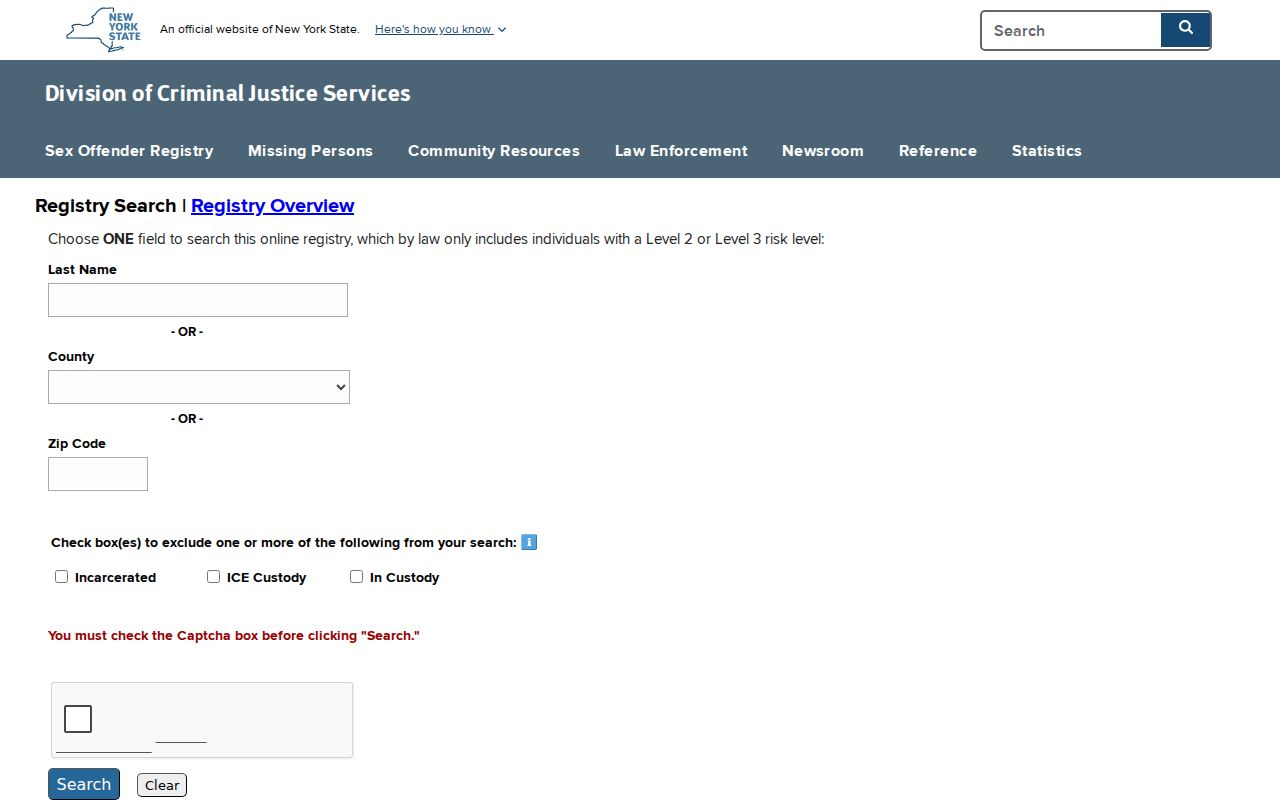
The official registry form is a restricted public-safety lookup. It is not a stand-in for an address, ownership, or household record.
New Rochelle Protected Address Rules
Some records should stop a search cold. New York's Address Confidentiality Program gives qualifying participants a substitute Albany mailing address, and agencies must use it unless the Department of State grants a statutory waiver. The program shields future and updated government records. It cannot scrub an address already printed in an older public record. Confidential voter registration under Election Law §5-508 sits in a separate file, closed to public inspection or copying except for election officials.
Federal law adds limits too. The Driver's Privacy Protection Act restricts motor-vehicle personal information. Sealed court files, adoption records, protected voter rolls, and confidential vital records also stay outside ordinary searches. A lawful public-records question never justifies republishing a private address, phone number, birth date, or protected location. When a source record is wrong, contact the custodian for a correction.